
Timelines Reimagined
TIMELINES: THE PROBLEM
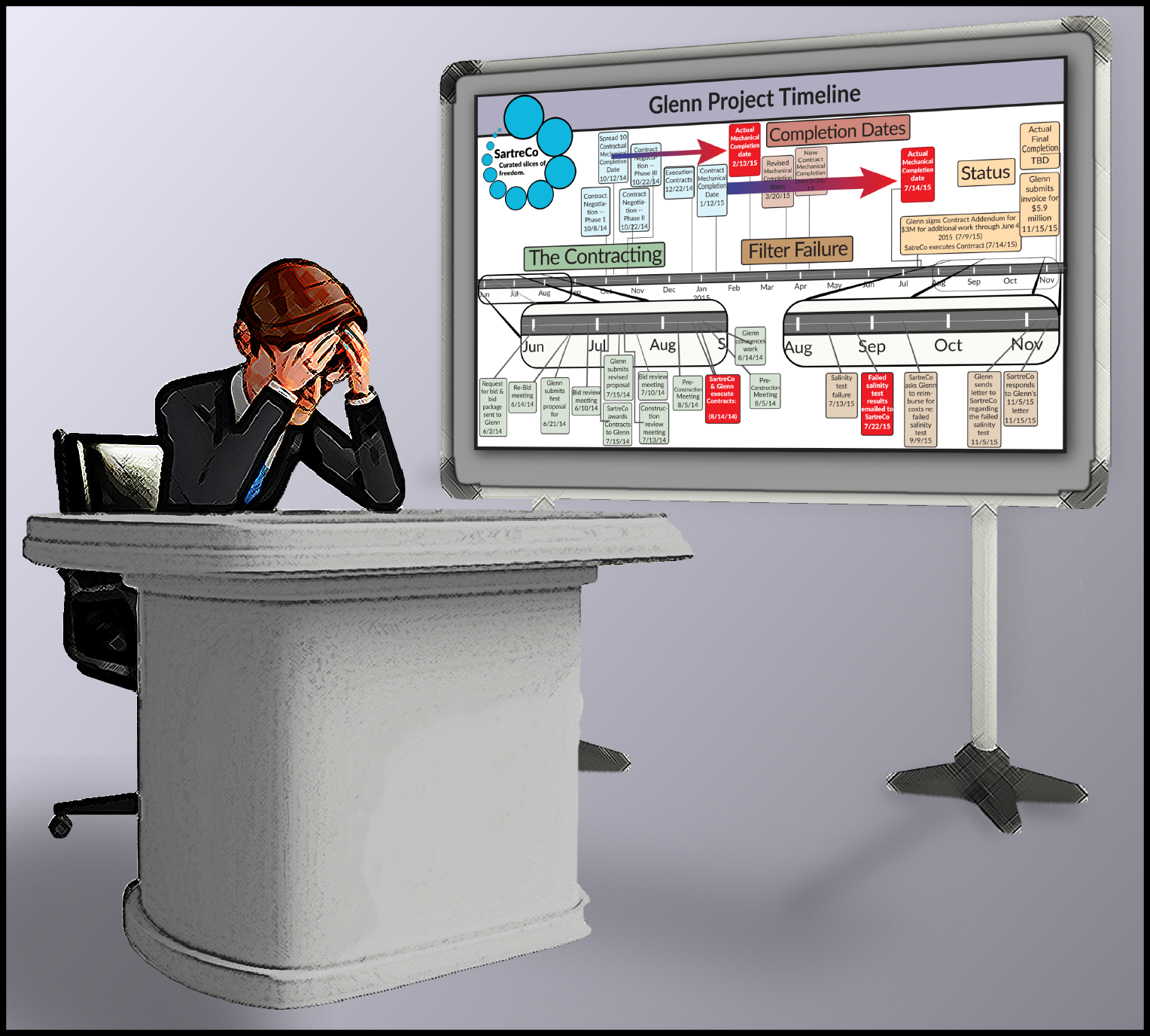
We’ve all seen them and most likely created them. Timelines begun with the most elegant of intentions that devolve into text box detritus connected via Gordian Knot.
Designing effective timelines is challenging. I get it. You need a wickedly sharp red pen. And a willingness to alter your approach (often) to fit changing data and messaging needs. Finally, you have to sweat the small stuff. Details like perfecting alignment and sizing, positioning and negative space, colors and fonts, all affect how our brains interpret relationships, assign relative values, and view credibility, i.e., how persuasive the timeline will be.
The Good News!
An ineffective timeline almost always springs from “Timeline Bloat”: crowding the visual with excessive data and design elements thereby minimizing the timeline’s communicative impact. Timeline bloat, however, is readily correctable (see below).
TIMELINES: THE VALUE
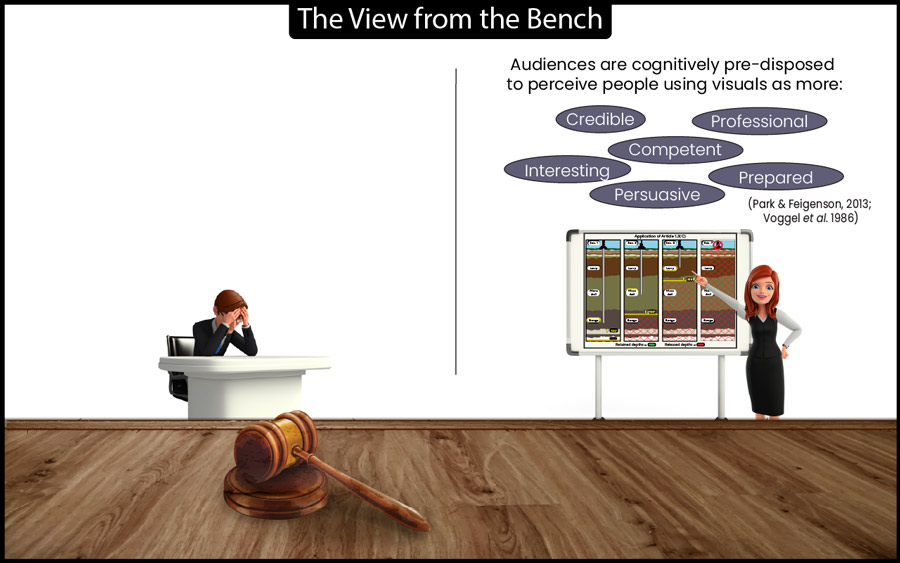
The time and money expended designing an effective timeline, however, is far outweighed by the accrued cognitive benefits, which serve to elevate specific issues, cases, and even the perception of the attorneys in the eyes of judges and jurors. Here’s why:
Timelines play to the brain. Narrative cognition (i.e., narratives serving as frameworks upon which cognition occurs) is now viewed as the mind’s default mode of thought and the foundation for memories. Narrative communications, such as timelines, use more efficient cognitive pathways yielding “intrinsic benefits in each of the four main steps of processing information: motivation and interest, allocating cognitive resources, elaboration [i.e., conscious analysis incorporating the recipients’ own experiences], and transfer into long-term memory.” (Michael F. Dahlstrom, 2014).

Timelines play to the proof. In most litigations, the facts themselves are not the critical feature of the case; rather, it is the relationships—the spaces—between the facts that drive outcomes. Timelines specifically, and visuals in general, use cognitive processes superior to all other communication forms to better guide judges and juries as to the case-critical relationships like causation, discontinuity, similarity, dissimilarity, and comparative sizes, values, and importance.
Timelines play to the preparation. In a practical sense, the act of creating and revising a timeline is an invaluable case development/trial preparation tool. Lawyers are forced to make the hard choices—identifying indispensable facts/relationships, meticulously refining trial themes, and selecting crucial witnesses.


TIMELINES: THE SOLUTION
To avoid Timeline Bloat while unlocking their cognitive benefits, I developed the Parent-Child Timeline System. Most cases will have one Parent Timeline encompassing, usually fairly generally, the entire duration of the dispute. This Parent serves as the narrative framework and contextual map upon which several Child Timelines (and rest of the evidence) are anchored.
The Children—each limited to a single message and its underlying fact-event—eliminate the otherwise ever-present clutter that so quickly reduces timeline effectiveness. The simplicity of the pared down Child timelines opens several avenues to increased persuasiveness.
The Children benefit from greater “processing fluency”: the ease with which stimuli is physically perceived and processed. Viewers of more easily processed stimuli (i.e., targeted timelines free from irrelevant data and distracting design) hold greater positive judgments about that stimuli, such as “more valuable,” “more honest,” “more pleasing,” “more sincere,” “greater confidence,” and “safer.” The Truth Effect—another cognitive mechanism—similarly leads viewers to judge more easily processed information as more truthful.
Clearing away the irrelevant also allows us to better direct attention to our Core Message using visual isolating and communicating techniques like contrasting colors, positioning, negative space, shapes, proximity, size, motion, and a host of other things.
In subsequent posts, I’ll address some other methods to isolate and emphasize your demonstrative’s Core Message, always with the goal of increasing your persuasiveness.

Kent Modesitt practiced as a complex, commercial trial attorney for 16 years. Visuals earned an increasing role in his legal career as he experienced the case-changing power of visuals time and again. Kent started Persuasion by Design, Ltd., to devote his practice to visual narrative consulting and demonstrative design.
If you’re interested in discussing how you and your practice can benefit from the scientifically proven benefits of visual, please reach out.
